
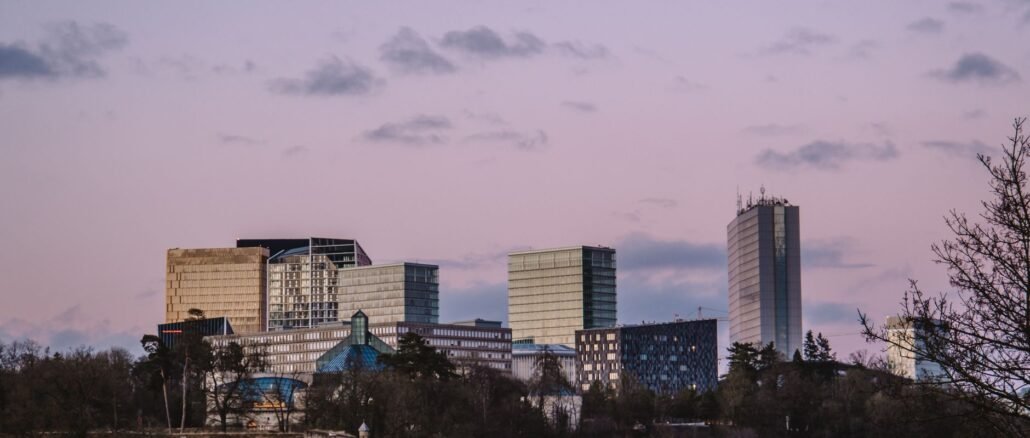
Luxembourg’s Prime Minister Luc Frieden told CNBC that space has become a critical technology sector and that Europe needs to secure a key role in its development. Frieden’s comments, published by CNBC’s Currents on September 9, 2026, tie Luxembourg’s own space strategy to a broader European debate over financial stability and industrial competitiveness. The interview frames space as core economic infrastructure, on par with other sectors Brussels has flagged for strategic protection, rather than a scientific curiosity.
What Frieden told CNBC about Europe’s space ambitions
Frieden used the interview to lay out what Luxembourg is doing to build up its own space economy, according to CNBC. He connected that national effort directly to a continental one, arguing that Europe as a whole cannot afford to sit on the sidelines while other regions consolidate their position in orbit and beyond.
The case for Europe playing a “key role” in space development
Frieden’s central argument, as reported by CNBC, is that it is “crucial that Europe plays a key role” in space development. He did not frame this as a matter of prestige. The headline from CNBC, “Space is a critical tech sector, Europe needs to be a key player,” puts space alongside other technologies that European governments now treat as matters of economic security rather than optional investment.
Space linked to Europe’s wider financial and economic crisis concerns
Frieden also addressed what Europe is doing to avoid a financial crisis, according to CNBC’s summary of the interview, linking the space discussion to broader economic concerns facing the continent. Raising these two topics in the same conversation suggests Luxembourg’s leadership sees space policy as part of Europe’s economic resilience strategy, not a separate track running alongside it.
Luxembourg’s bet on becoming a space economy hub
Luxembourg has spent years positioning itself as an outsized player in a sector dominated by countries many times its size. Industry coverage, including a special focus publication on Luxembourg’s space sector, describes the country as “becoming one of the most influential players in the global space economy,” built on what that coverage calls precision and coordination in how the country organizes its space industry.
Small country, outsized role in satellite and space finance
Luxembourg’s status as a major player in satellite services is well documented. A case study from the Aerospace Center for Space Policy and Strategy describes Luxembourg’s space policy and strategy as “a unique case study for space sector growth,” pointing specifically to the country’s status as a major player in the satellite industry. That didn’t happen by accident: Luxembourg built its space ambitions on top of an existing financial services base, using the same regulatory and capital-markets infrastructure that made it a hub for investment funds to attract satellite operators and space finance activity.
State backing and policy support for space firms
Luxembourg’s approach combines direct government involvement with infrastructure investment. One example cited in industry coverage is HITEC Luxembourg’s Orbital Ground Station, described as part of the country’s effort to “help lead the charge in the global space industry.” That framing, that “space is the future of our economy and security,” echoes Frieden’s own language in the CNBC interview and points to a policy line that treats space infrastructure as a national economic asset rather than a research project.
Why space now counts as critical technology, not niche science
Frieden’s “critical tech sector” framing is not an isolated claim. It matches how EU-level policy documents have started to categorize space capability alongside defense and security technology. A report on identifying future critical technologies for space, defense and related sectors states that the EU goal “should be to develop an open strategic autonomy on key capabilities, reinforce cooperation with other countries where possible and build independent” capacity where it cannot. That is the same logic Frieden applied to Luxembourg’s national strategy, scaled up to the EU level.
Overlap with defense, security, and strategic autonomy goals
The line between civilian space infrastructure and defense capability has narrowed. Satellite communications, earth observation, and orbital positioning systems now sit at the center of both commercial space economies and national security planning, which is precisely why EU policy documents group space and defense technologies together when discussing strategic autonomy. Frieden’s comments to CNBC fit that pattern: calling space “critical” implicitly links it to the same security concerns driving European defense spending debates.
How this fits the EU’s broader critical-technology push
The European Commission and member states have been building a wider critical-technology agenda that extends beyond space. A related document, the European CEO AI and critical tech declaration, argues that Europe “must adapt to faster innovation cycles, make agile investments, reduce regulatory burden and costs of failure, simplify implementation.” That same language of urgency and competitive catch-up runs through Frieden’s space comments, suggesting Luxembourg’s leadership sees space as one front in a larger effort to keep European industry competitive in technologies where the US and China are moving faster.
Europe’s competitive position against the US and China
Frieden’s call for Europe to be a “key player” implies the alternative: playing a secondary role behind rivals already ahead in the sector. Research and commentary on Europe’s space ambitions consistently return to this competitive framing rather than treating European space policy in isolation.
Investment gaps and dependency risks
A piece examining what role Europe wants to play in the next era of space exploration notes that collaborative efforts among European space stakeholders “stress the critical need for Europe to boost its ambitions and capabilities in both human and robotic space” programs. That points to a gap between where Europe’s space capability currently stands and where its own policy community believes it needs to be, particularly in areas requiring sustained, large-scale investment such as crewed spaceflight and robotic exploration missions.
Where Europe already leads: satellite communications and regulation
Europe’s strongest position remains in satellite communications and the regulatory frameworks that support them, the area where Luxembourg itself has built its space economy niche. The country’s role as “a major player in the satellite” industry, as described by the Aerospace Center for Space Policy and Strategy, reflects a broader European strength in commercial satellite operations and the legal and financial architecture that supports them. That’s a narrower lead than the ambitions Frieden described to CNBC, but it’s a concrete one, built over decades rather than announced in a single policy document.
What comes next for Luxembourg and EU space policy
Frieden’s CNBC interview did not detail specific new funding commitments or legislative proposals. What it did establish is a public marker from a sitting EU head of government: space now belongs in the same policy category as other technologies Europe has designated critical, and failing to compete in it carries the same economic risk as falling behind in semiconductors, AI, or defense manufacturing.
Signals to watch from Brussels and member states
The near-term test will be whether the EU’s critical-technology framework, referenced in reports on space and defense technology identification, turns Frieden’s rhetoric into funding decisions and coordinated procurement across member states. Luxembourg has already shown, through its satellite finance sector and infrastructure projects like HITEC’s ground station, what a small state can do with focused policy and capital. Whether the broader EU follows that model at scale, particularly on strategic autonomy in space capabilities, is the question Frieden’s comments leave open for Brussels to answer.
Be the first to comment